

 Latviešu
 Русский
Spanish has a letter that does not exist in any other language in the world. More precisely, ñ also occurs in other languages, but Spanish is the language that has truly made it its linguistic symbol. You can see it on signs, in names, books and even on souvenirs – España (Spain), niño (boy), mañana (tomorrow). And that is a very Spanish story: to sound bright, distinctive and just a little bit full of character.
Spanish belongs to the Romance group of the Indo-European language family and developed from vernacular Latin. This group also includes Italian, French, Portuguese, Romanian and several other languages. Spanish is an official or state language in 20 countries, stretching geographically from Europe to Latin America.
And Spanish is not quite the same everywhere. Madrid, Mexico City, Buenos Aires and Havana each have their own linguistic character. For example, in Spain, z and c before e, i are often pronounced as [θ], while in most of Latin America they are pronounced as [s]. In some regions, speakers use vos instead of tú. These are not mistakes, but natural regional varieties of Spanish.
Why is Spanish relatively easy to start learning?
Five basic vowel phonemes. Spanish has /a e i o u/, and their pronunciation is relatively stable. This makes reading aloud much more predictable than in English. Take tomate, for example.
Its consonants also have some interesting features. The letter j represents the voiceless fricative [x]: jardín [xaɾˈðin] (“garden”). The letter ñ represents the palatal nasal [ɲ]: niño [ˈniɲo] (“boy”). And Spanish r can be either a tap [ɾ] or a trill [r]: compare pero (“but”) and perro (“dog”).
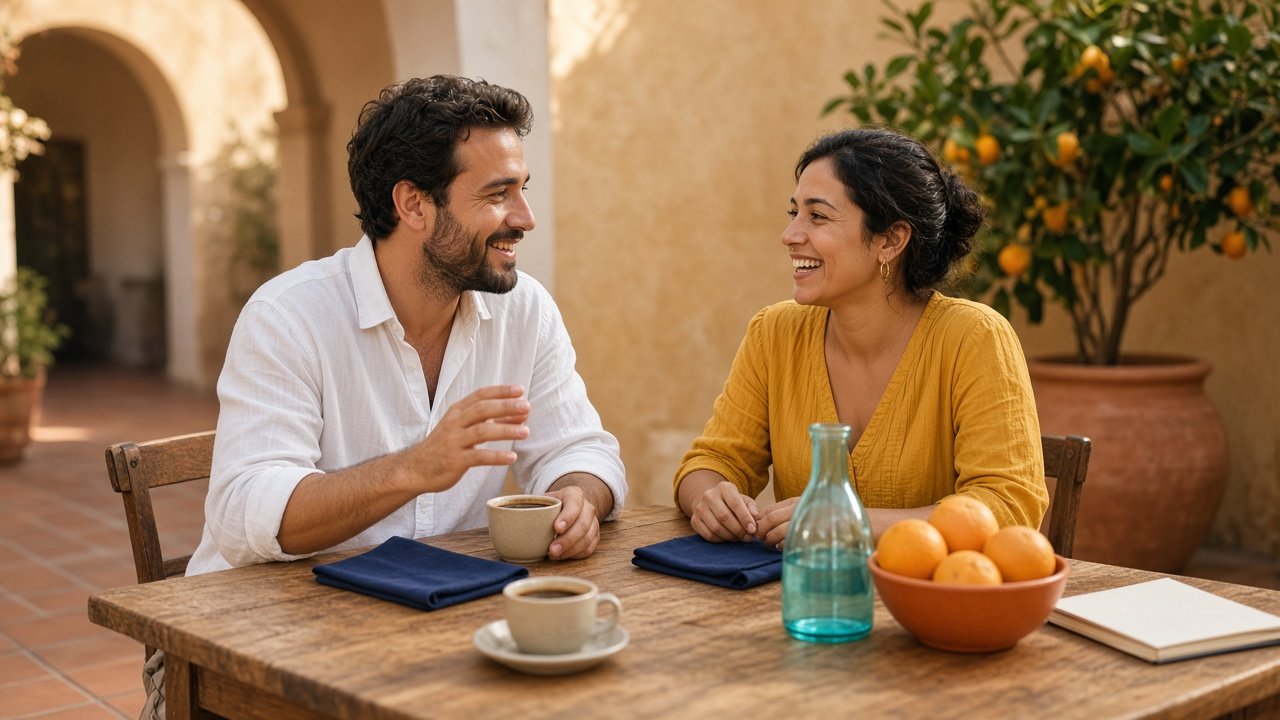
At first, Spanish is relatively easy to approach: spelling and pronunciation are quite predictable, basic sentence structures are straightforward, and speakers of English, French or Italian will recognize many familiar words.
The real challenge comes later: the verb system, agreement, the subjunctive mood, pronouns and regional differences. Spanish requires systematic practice, but the results are well worth it.
And why is Spanish so attractive? Spain, Latin American countries, literature and cinema, a rich history, flamenco and reggaeton, tapas and tacos, Machu Picchu… Spanish opens the door to a huge and diverse cultural world.
🔎 3 Facts for the Curious
- Why does Spanish have an inverted question mark? A question mark appears both at the beginning and at the end of a question: ¿Qué tal? (“How are you?”), ¿Cómo estás? (“How are you?”). This allows the reader to anticipate the intonation before reaching the end of the sentence.
- Ñ appeared thanks to medieval scribes. Medieval scribes used a tilde to mark a doubled n. Over time, this abbreviation developed into the independent letter ñ.
- Spanish ojalá (“if only”) comes from Arabic and is connected with in shā’ Allāh – “if God wills”. This is a linguistic trace of more than seven centuries of Arabic presence on the Iberian Peninsula.
✈️ Spanish for Travel
The transcription is given in the International Phonetic Alphabet (IPA). Pronunciation of individual words may vary slightly depending on the region.
| Spanish | Transcription | English |
|---|---|---|
| ¡Hola! | [ˈola] | Hello! / Hi! |
| Buenos días. | [ˈbwenos ˈdi.as] | Good morning! |
| Por favor. | [poɾ faˈβoɾ] | Please. |
| Gracias. | [ˈɡɾaθjas] / [ˈɡɾasjas] | Thank you. |
| ¿Cuánto cuesta? | [ˈkwanto ˈkwesta] | How much does this cost? |
| ¿Dónde está…? | [ˈdonde esˈta] | Where is…? |
| Quiero esto, por favor. | [ˈkjeɾo ˈesto poɾ faˈβoɾ] | I want this, please. |
| La cuenta, por favor. | [la ˈkwenta poɾ faˈβoɾ] | The bill, please. |
| ¿Habla inglés? | [ˈaβla iŋˈɡles] | Do you speak English? |
| No entiendo. | [no entjenˈdo] | I don’t understand. |
| ¿Puede repetir, por favor? | [ˈpweðe repetiɾ poɾ faˈβoɾ] | Could you repeat, please? |
| ¡Ayuda! | [aˈʝuða] | Help! |
| ¿Cómo está? | [ˈkomo esˈta] | How are you? (formal) |
| ¿Cómo estás? | [ˈkomo esˈtas] | How are you? (informal) |
| Bien. | [bjen] | Good. |
| Regular. | [reɣuˈlaɾ] | So-so. / Okay. |
| Mal. | [mal] | Bad. / Not well. |
| ¡Qué bonito! | [ke βoˈnito] | How beautiful! |
| ¡Qué rico! | [ke ˈriko] | How delicious! |
| Me gusta. | [me ˈɣusta] | I like this. |
| No me gusta. | [no me ˈɣusta] | I don’t like this. |
Linguistic comment: ¡Qué bonito! is closer to “How beautiful!” / “How lovely!”, while for a landscape or a place, ¡Qué hermoso! (“How wonderful!”) is also very natural. ¡Qué rico! is especially characteristic of Latin America; in Spain, ¡Qué bueno! (“How delicious!”) is very natural when talking about food.
Spanish quickly allows you to feel like a participant rather than an observer: a phrase in a café, a question in the street, a short exchange in a shop. ¡Hasta luego! – See you soon! Parents looking at Spanish for school-age children may also like Lingua KIDs and our guide on when to start a foreign language with a child.