

 Latviešu
 Русский
In Russian, stress can completely change the meaning of a word. Compare за́мок (castle) and замо́к (lock): the spelling is identical, yet we are dealing with two different words. This is a small illustration of why Russian can seem both challenging and remarkably fascinating.
Russian belongs to the Slavic group of the Indo-European language family and, within it, to the East Slavic subgroup, alongside Ukrainian and Belarusian. Modern Russian developed from East Slavic dialects, while its written tradition goes back many centuries. At the same time, Russian has proved remarkably open to borrowing: at different periods it actively absorbed vocabulary from other languages. Just a few examples: from Dutch came яхта (yacht), матрос (sailor), каюта (cabin); from German – бутерброд (sandwich), рюкзак (backpack), галстук (tie); from French – пальто (coat), меню (menu), балет (ballet); and from English – футбол (football), компьютер (computer), менеджер (manager). For learners of Russian, this is a pleasant bonus: many words are already familiar or can be easily recognised from their sound and meaning.
Today, Russian is one of the most widely spoken languages in Europe and Eurasia. According to Ethnologue, in 2026 around 210 million people use Russian, placing it 11th in the world by total number of speakers and approximately 7th by number of native speakers. Russian is spoken not only in Russia but also in many countries with established Russian-speaking communities. In addition, Russian is one of the six official languages of the United Nations.
Why is Russian considered difficult?
The main reason is grammar. Russian has six main cases – nominative, genitive, dative, accusative, instrumental and prepositional. By changing word endings, Russian expresses the relationships between words. As a result, word order in a sentence can be much freer than, for example, in English.
Another distinctive feature is verbal aspect. Russian distinguishes between completed (perfective aspect) and incomplete or ongoing (imperfective aspect) actions. For example, читать (to read) – прочитать (to read through / finish reading), делать (to do) – сделать (to do / complete). For someone accustomed to the English tense system, this logic may initially seem unfamiliar.
Russian stress is free and mobile: it can fall on different syllables and shift when different forms of a word are formed.
There is good news, too: Russian spelling is largely systematic, and grammatical structures follow fairly clear patterns. Once the logic begins to fall into place, the language stops looking like a chaotic collection of exceptions.
Russian is known for its ability to convey subtle shades of attitude, emotion and meaning with great precision. Compare дом (house/home), домик (little house), домишко (a shabby/little house): the suffix tells us not only about size, but also about the speaker’s attitude towards the house.
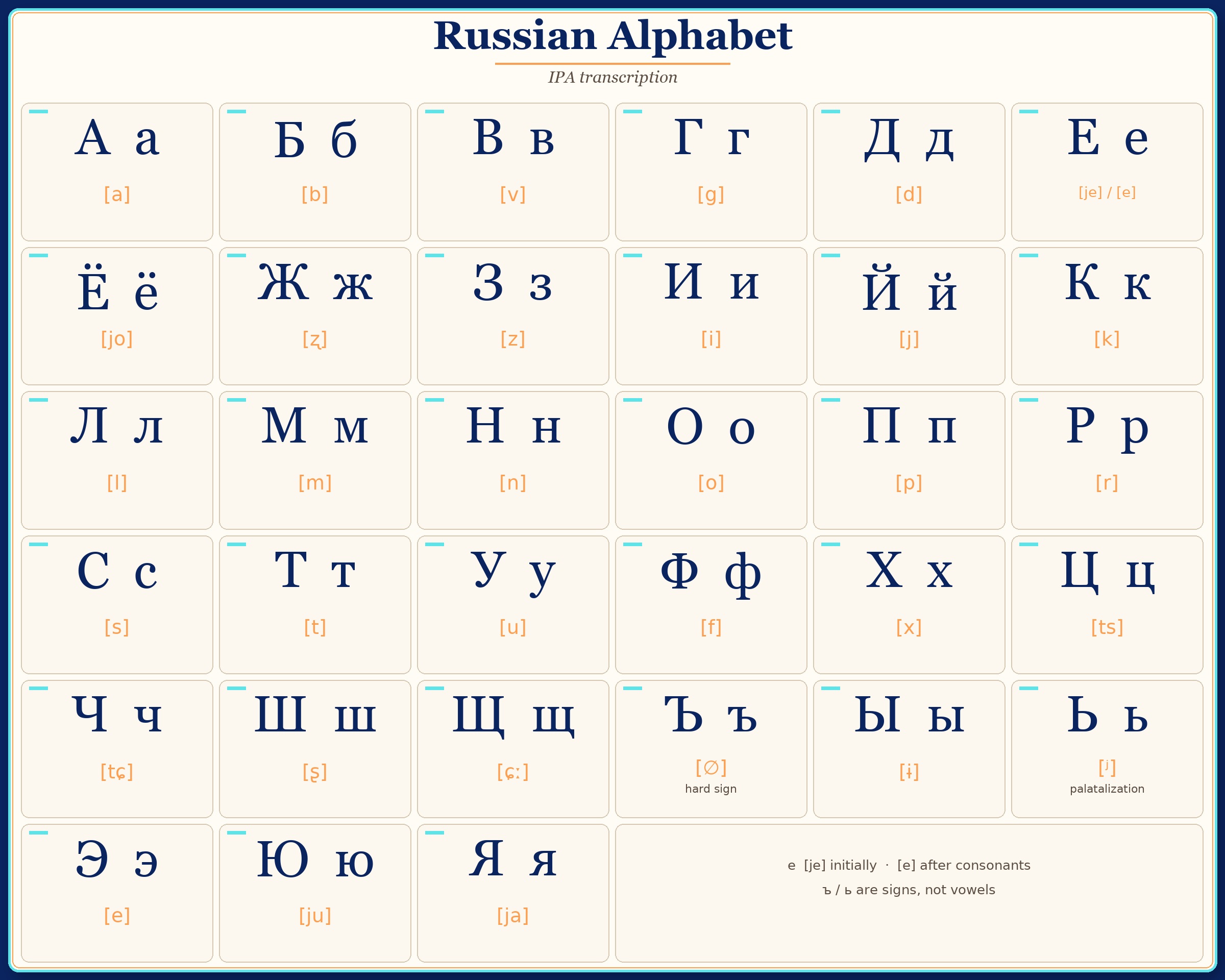
🔎 4 Facts for the Curious
- You can say “I love you” without the pronoun “I”. The verb form already indicates the person: люблю (I love). Personal pronouns can therefore often be omitted. This is known as a null subject and can make a phrase more concise or shift the focus of the intonation.
- Some words cannot be translated precisely with a single English word. A famous example is тоска (a profound feeling of melancholy/longing), whose meaning has to be conveyed descriptively. Such cases show particularly well that languages do not simply label pre-existing concepts; they also express human experience in different ways.
- Спасибо was once a whole phrase. The word спасибо (thank you) is historically connected with the expression «спаси Бог» (may God save you). Over time, the phrase gradually became a single word.
- It is used in space. Russian is one of the working languages of the International Space Station. Astronauts therefore have to learn the language not only for communication, but also for carrying out professional procedures.
✈️ Travel Russian
| Русский | Транскрипция | English |
|---|---|---|
| Здравствуйте! | [ˈzdrastvʊjtʲe] | Hello! |
| Привет! | [prʲɪˈvʲet] | Hi! |
| Как ваши дела? | [kak ˈvaʂɨ dʲɪˈla] | How are you? |
| Как твои дела? | [kak tvɐˈi dʲɪˈla] | How are you? |
| Хорошо. | [xərɐˈʂo] | Good. |
| Нормально. | [nɐrˈmalʲnə] | Fine. / Okay. |
| Плохо. | [ˈploxə] | Bad. / Not well. |
| Спасибо. | [spɐˈsʲibə] | Thank you. |
| Пожалуйста. | [pɐˈʐalʊjstə] | Please. / You’re welcome. |
| Сколько это стоит? | [ˈskolʲkə ˈɛtə ˈstoɪt] | How much does this cost? |
| Где находится…? | [ɡdʲe nɐˈxodʲɪt͡sə] | Where is…? |
| Мне это нравится. | [mnʲe ˈɛtə ˈnravʲɪt͡sə] | I like this. |
| Мне это не нравится. | [mnʲe ˈɛtə nʲe ˈnravʲɪt͡sə] | I don’t like this. |
| Очень вкусно! | [ˈot͡ɕɪnʲ ˈfkusnə] | It’s delicious! |
| Как красиво! | [kak krɐˈsʲivə] | How beautiful! |
| Я не понимаю. | [ja nʲe pɐnʲɪˈmaju] | I don’t understand. |
| Вы говорите по-английски? | [vɨ ɡəvɐˈrʲitʲe pɐ ɐnɡlʲɪjskʲɪ] | Do you speak English? |
| Можете повторить, пожалуйста? | [ˈmoʐɨtʲe pəftɐˈrʲitʲ pɐˈʐalʊjstə] | Could you repeat, please? |
Learning Russian does require patience: you need to get used to cases, verbal aspect, mobile stress and the many forms words can take. Yet it is precisely this complexity that makes the language so expressive. Once you master the system, you discover a language in which a suffix can add emotion, while a single short word can convey an entire mood.
And perhaps that is why Russian is so fascinating not simply to learn, but to gradually decode.
To turn travel phrases into real conversation, join our Speaking Club — and if you’re choosing Russian for a child, see Lingua KIDs.